Pune Sees First 35°C Day Of 2026 As Temperatures Rise In Koregaon Park And Lohegaon
Maharashtra Weather Alert For May 12: IMD Issues Yellow Alert For 6 Districts
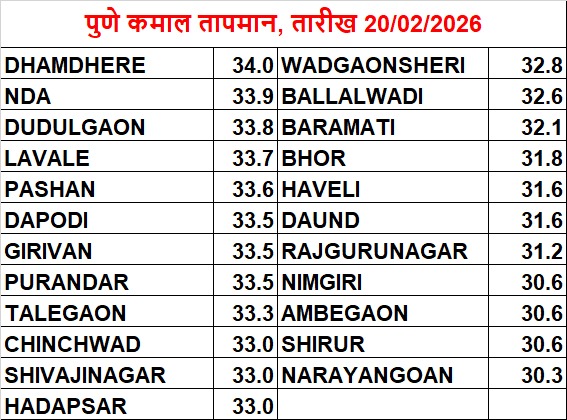
Pune, February 21, 2026: Signalling an early build-up to summer, day temperatures in Pune crossed the 35°C mark for the first time this year, with Koregaon Park and Lohegaon recording season-high readings on February 20.
According to data from the India Meteorological Department (IMD), Koregaon Park registered a maximum temperature of 35.3°C, while Lohegaon recorded 35.1°C. This marks the first instance in 2026 that any monitoring station in the city has reported temperatures above 35°C. The IMD has forecast that above-normal temperatures are likely to persist for the next two to three days.
Over the past week, both daytime and nighttime temperatures have remained elevated across the city. Minimum temperatures in several areas have ranged between 18°C and 21°C. On Friday, Shivajinagar recorded a minimum of 17.5°C, which is four degrees above normal, while its maximum temperature stood at 33°C, within the typical range for this period.

However, neighbourhoods such as Koregaon Park and Lohegaon, which are known to experience the urban heat island effect, reported comparatively higher daytime readings. Although the IMD considers March as the official start of the summer season, residents have begun experiencing summer-like conditions in the latter half of February.
The IMD’s latest weather bulletin noted the presence of multiple weather systems across the country. A low-pressure area over the equatorial Indian Ocean and adjoining southwest Bay of Bengal has weakened, though the associated upper air cyclonic circulation remains active and is expected to move west-northwest towards Sri Lanka. Another cyclonic circulation over the equatorial Indian Ocean and adjoining southeast Bay of Bengal may develop into a fresh low-pressure system within the next 48 hours.
In addition, a trough extends from the equatorial Indian Ocean to the Lakshadweep region across parts of south Tamil Nadu and Kerala. A western disturbance is currently positioned as a trough from central Uttar Pradesh to north Gujarat via east Rajasthan at mid-tropospheric levels. Other upper air circulations are present over south Haryana and adjoining Punjab, northeast Assam and east Bangladesh. The subtropical westerly jet stream, with core wind speeds of around 95 knots, prevails over northeast India, while a weak western disturbance is expected to influence the western Himalayan region from February 22.
Under the impact of these systems, parts of Maharashtra have been witnessing moisture incursion, leading to intermittent cloud cover. Pune has also experienced partly cloudy skies, which have contributed to heat retention in the lower atmosphere.